Sand Gazelle
Gazella subgutturosa marica
Order: Artiodactyla
Family: Bovidae
1) General Zoological Data
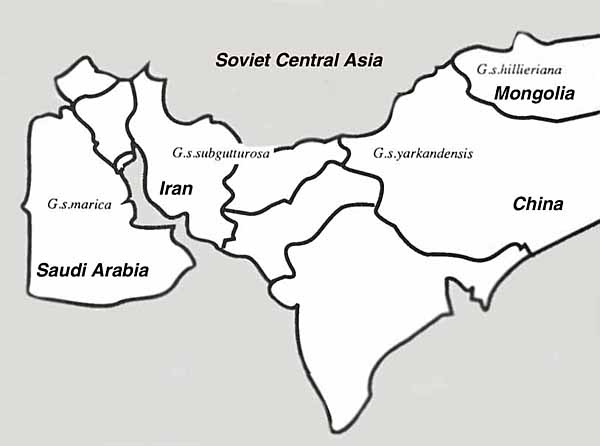
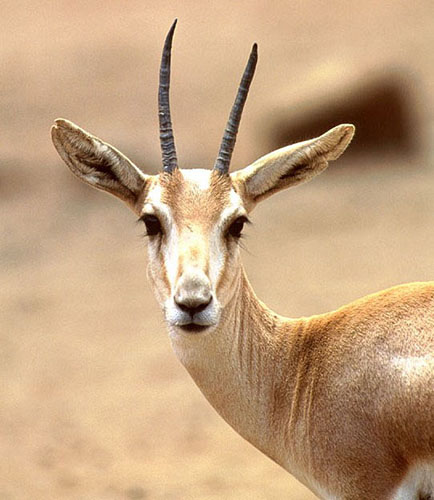
The goitered gazelle, Gazella subgutturosa, inhabits desert and sub-desert steppes of the Arabian peninsula and southwestern Asia to northern China and Mongolia. Four subspecies are recognized by Groves (1985), two of which are presently maintained in captivity in North America. The Arabian sand gazelle, G. s. marica, was once common in the Arabian peninsula, ranging north through eastern Jordan and Iraq, where its range integrated with that of G. s. subgutturosa, commonly known as the Persian or goitered gazelle. Persian gazelles once ranged from eastern Turkey through Iran, Pakistan and Soviet Central Asia. The two forms that are not maintained in North American collections are the Xinjiang goitered gazelle, G. s. yarkandensis, found in the deserts of the Tarim Basin, Xinjiang, China, and the Mongolian goitered gazelle G. s. hilleriana, native to the Gobi and Caidam (Groves, 1985, see Fig. 1). The only captive records of these forms are from European collections. These records indicate that G. s. hilleriana specimens were present in the Opel Zoo as recently as the 1970's, while four G. s. yarkandensis were held by the Berlin Zoo from 1904 to 1906."
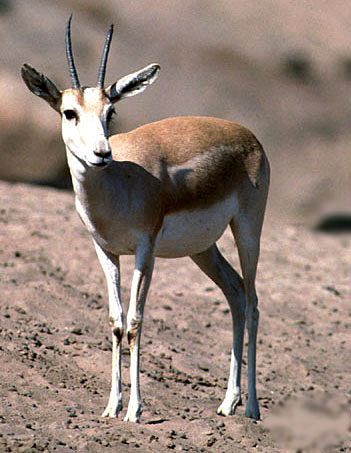
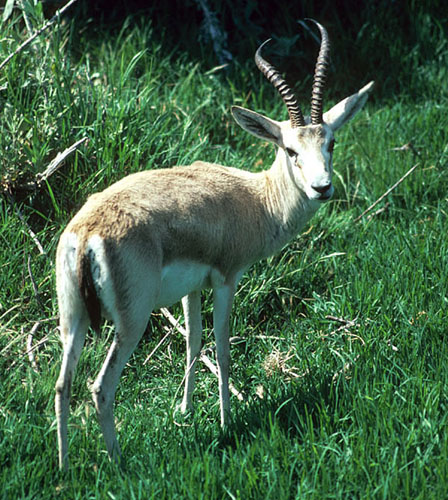
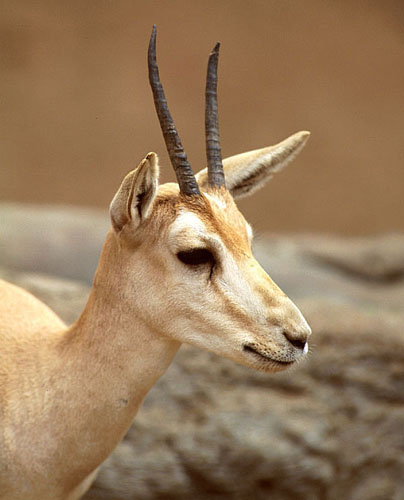
This information has been taken from the studbook report's initial statement (Carter & Kingswood, 1991). Relatively small colonies of sand gazelles are now held in a few zoos, both in Europe and in the USA. It has apparently been difficult to differentiate clearly between the different phenotypes by mere inspection of the four subspecies, if this is possible at all. This is also apparent from the next two photographs shown here. Perhaps specific phenotypes have special, as yet unrecognized chromosomal characteristics as well. I am not aware that such comparisons (karyotypes with photographs) have ever been attempted. Rostron (1972) did a careful study of skull measurements of Arabian gazelles and thereby assigned species designation.
The sand gazelle, as well as some related gazelles (e.g. slender-horned) have also been called "rheem" or "rhim", without proper identification of the species. Nevertheless, parasites are named after the "rheem" (e.g. Eimeria rheemi).
Female sand gazelles usually have horns, while typical goitered gazelles rarely do. They are also lighter in coloration and smaller than "Persian gazelles" (G. s. subgutturosa). The animals weigh up to 22 kg; newborns are approximately 2.5 kg.
|